OpenClaw Memory Vectorize is the most infrastructure-forward version of agent memory in our stack right now: not just "store notes somewhere", but "turn memory into a first-class edge service with retrieval, classification, and agent hooks built in."
After reviewing the repo, worker code, plugin hooks, and current documentation, the shape is clear:
- a Cloudflare Worker exposes the memory API,
- Workers AI creates embeddings,
- Vectorize handles semantic recall,
- R2 stores source files and memory inputs,
- and both OpenClaw and Hermes can sit on top of the same memory service.
That matters because most agent memory conversations stay at the product layer. This one is closer to an operating-system component.
The core idea is simple: agents should not have to ask to remember everything manually, and they should not lose the plot every time the context window rolls over.
What the repo is actually building
At a high level, the project is a semantic long-term memory layer for AI agents. The README frames the problem in the usual way—keyword recall is brittle, context windows forget, and cross-session continuity breaks down—but the interesting part is the implementation choice.
Instead of centering everything on a monolithic app database, OpenClaw Memory Vectorize uses Cloudflare primitives directly:
Vectorizeas the searchable vector index,Workers AIwith thebge-base-en-v1.5embedding model,R2buckets for memory files and attached source documents,- a Worker API with
/query,/index,/capture,/index-file,/stats, and/health, - and two integration surfaces: an OpenClaw plugin and a Hermes MemoryProvider.
That last part is the real differentiator. This is not only a memory backend; it is a memory backend that already understands the shape of the agent runtimes using it.
The architecture in one picture
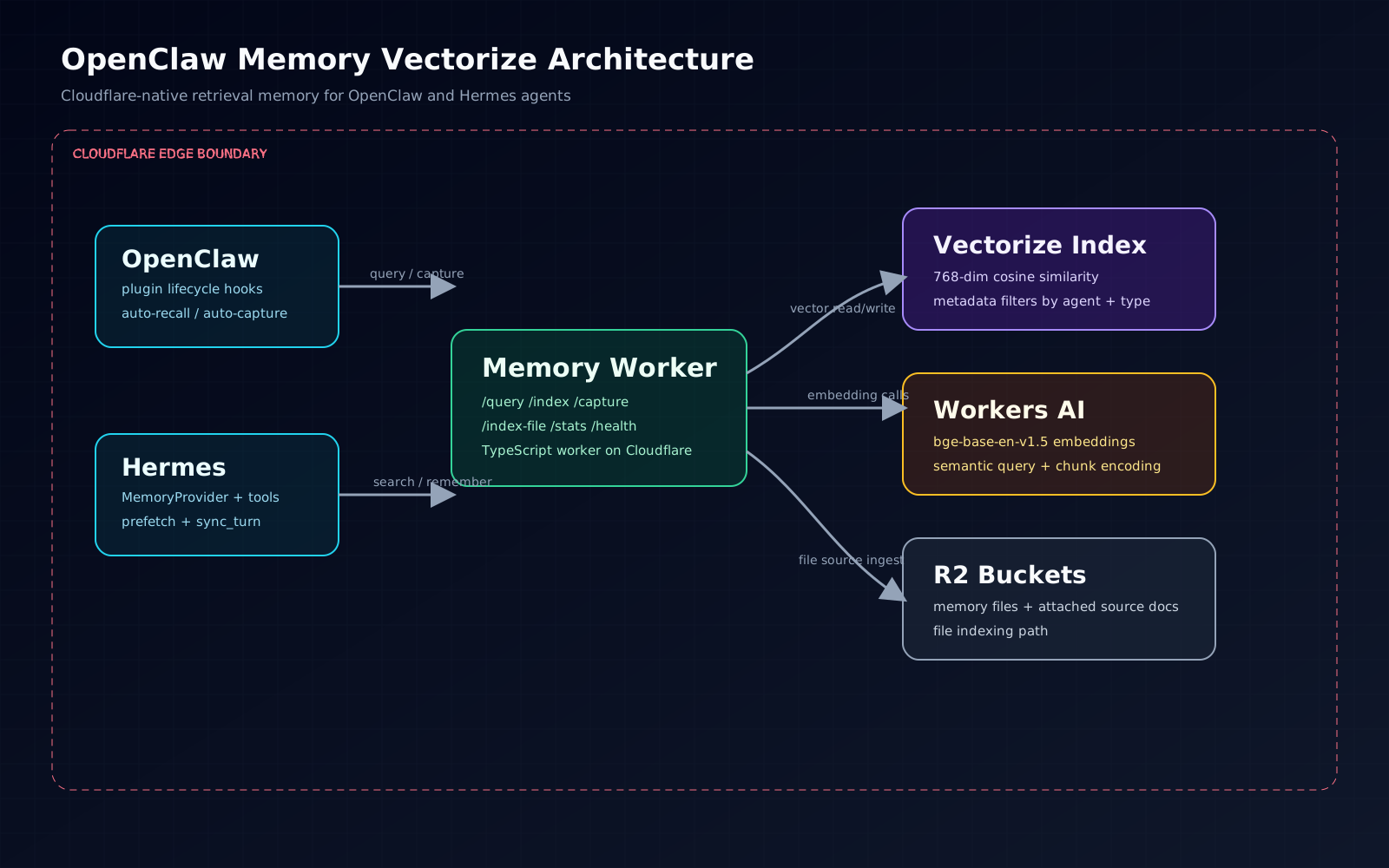
The worker code shows a fairly direct flow:
- Incoming agent request asks for recall or sends a memory to store.
- The Worker generates an embedding through Workers AI.
- The embedding is read from or written to Vectorize.
- Metadata keeps track of agent scope, memory type, source file, timestamp, and chunk index.
- For larger source material, the worker can also pull a file from R2, chunk it, embed it, and index it.
The current metadata model is practical and small:
decisioncorrectionlearningpreferencecontextuser_profile
That is a good sign. A lot of memory systems get fuzzy because they try to be too clever too early. This one keeps the taxonomy narrow enough to be useful in production.
Why the OpenClaw plugin layer matters
The OpenClaw plugin is where the project starts to feel opinionated instead of generic.
The plugin does two important jobs:
1. Auto-recall before the agent runs
On the before_agent_start hook, it queries the worker with the current prompt and injects matching results back into the conversation context inside a <relevant-memories> block.
That means memory is not only a tool the model can use. It becomes part of the execution path.
2. Auto-capture after the agent finishes
On agent_end, the plugin scans recent user/assistant text and looks for capture-worthy signals like:
- decisions,
- corrections,
- preferences,
- personal facts,
- and explicit "remember this" style language.
It then sends the strongest candidates back to the worker through /capture.
That is the part I like most. It shifts memory from manual bookkeeping to agent-side habit.
Hermes gets a real memory provider, not just a sidecar
The repo also includes a Hermes MemoryProvider, which is the second reason the design is interesting.
That provider does more than register a pair of tools. It also:
- advertises itself in the Hermes system prompt,
- supports prefetch of relevant memories before a run,
- supports sync_turn so completed turns can be captured in the background,
- scopes recall to the active agent identity,
- and exposes explicit tools for search and durable storage.
In other words: OpenClaw gets plugin hooks, Hermes gets a provider abstraction, and both can point at the same Cloudflare worker.
That is the beginning of a shared memory substrate across multiple agent personalities instead of one assistant with one notebook.
Where it stands against the larger memory players
The broader memory landscape is crowded now, but the shape of the main options is pretty different depending on what you want control over.
Using the current repo/docs review plus public GitHub and docs surfaces, here is the practical positioning:
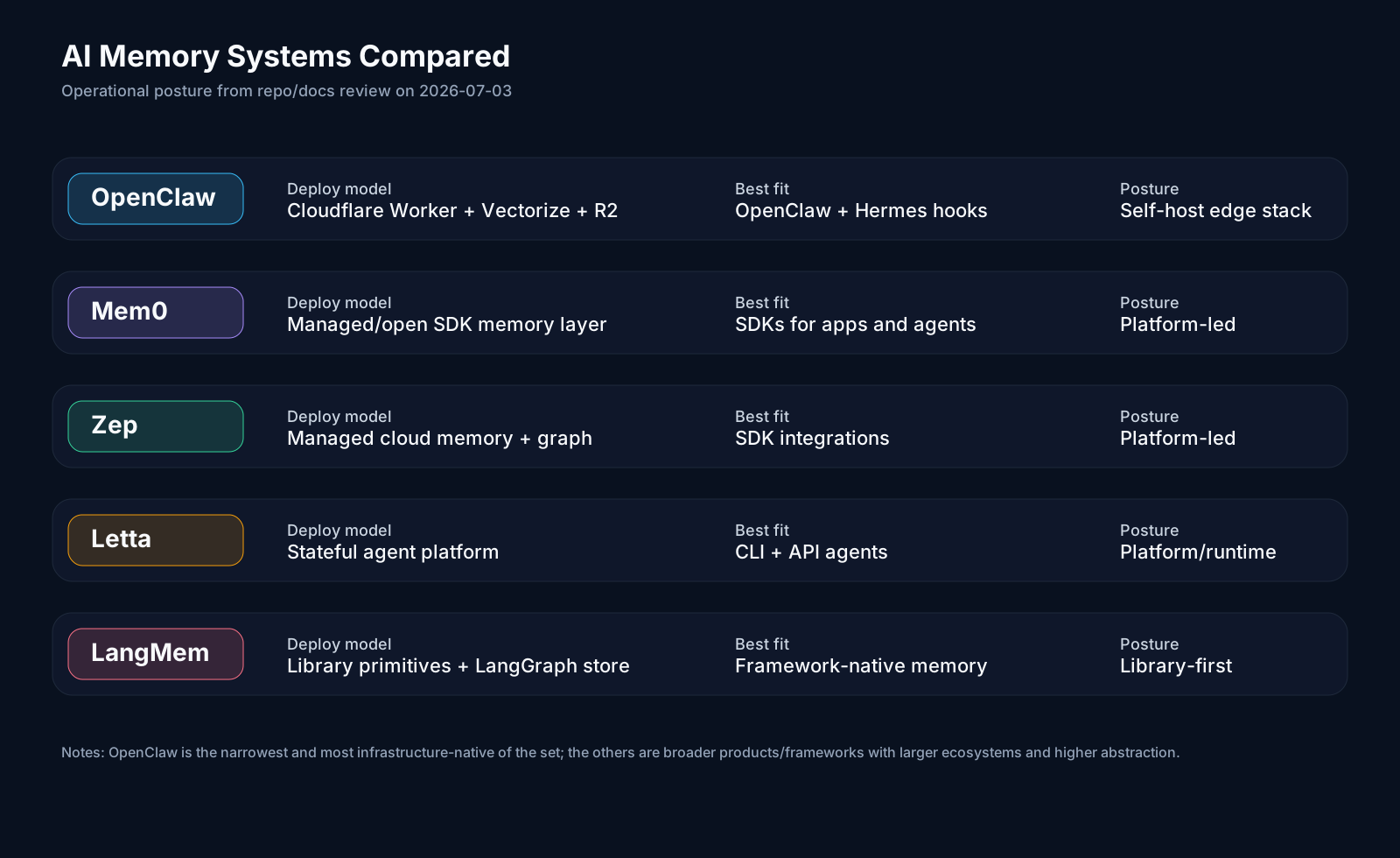
| System | Public positioning | Operational shape | Best fit |
|---|---|---|---|
| OpenClaw Memory Vectorize | Cloudflare-native semantic memory for agents | Self-hosted edge worker with Vectorize, Workers AI, and R2 | Teams that want infra control and agent-native hooks |
| Mem0 | "AI memory layer" for agents and apps | Bigger SDK/platform ecosystem | Product teams that want a broader plug-in memory product |
| Zep | Managed agent memory / graph platform | Cloud service with SDK integrations | Teams that want hosted memory and richer managed abstractions |
| Letta | Stateful agent platform | Memory as part of a full agent runtime | Teams that want the runtime and the memory together |
| LangMem | Memory primitives for LangGraph / libraries | Framework-first toolkit | Builders already living inside LangGraph-style orchestration |
A few observations stand out.
OpenClaw is narrower, but more controllable
OpenClaw does not try to be the biggest ecosystem in this group. It is much smaller by public footprint than Mem0 or Letta, and more infrastructure-opinionated than LangMem.
That is not a weakness if your real goal is this:
- keep the memory plane close to your own agent runtime,
- keep retrieval under your own Cloudflare account,
- and avoid handing core memory behavior to a black-box platform.
The differentiator is not "vector search"
Everybody says vector search now. That is table stakes.
The real differentiator is where memory plugs into behavior.
- Mem0 is selling a memory layer.
- Zep is selling a hosted memory/graph product.
- Letta is selling a stateful agent runtime.
- LangMem is selling memory primitives and workflow patterns.
- OpenClaw Memory Vectorize is building a portable memory service with runtime-specific hooks for OpenClaw and Hermes.
That makes it feel less like SaaS and more like infrastructure.
What I would call strong in the current design
1. Cloudflare-native all the way through
The stack is coherent:
- embeddings from Workers AI,
- vector search in Vectorize,
- source material in R2,
- HTTP API from a Worker.
No part feels stapled on from a different hosting worldview.
2. The memory types are grounded
The categories are exactly the kinds of things that matter in long-term agent usefulness:
- user preferences,
- corrected facts,
- decisions,
- learnings,
- and durable context.
That is better than pretending every message deserves equal retention.
3. Dual integration is a real advantage
Supporting both OpenClaw plugin hooks and Hermes provider hooks means the repo is already thinking beyond a single interface.
That is important if your future is multiple named agents with different jobs but overlapping institutional memory.
What still looks early
This is the honest part.
A few things still read like an early but promising build rather than a finished memory platform.
1. Optional auth is present, but not strongly enforced in the worker path
The worker code reads an authorization header and exposes an optional gateway token field, but the main request paths are still fairly light on enforcement logic.
That is workable for controlled environments, but if this memory layer becomes more central, the auth story should get stricter.
2. Some documentation outruns the verified implementation
The README mentions duplicate prevention at a high similarity threshold, but that exact guard is not obvious in the worker code path I reviewed.
That does not mean the idea is wrong. It means the docs and the live implementation need to stay tightly aligned as the system matures.
3. The strongest value is operational, not yet productized
Right now the repo already has a compelling architecture story. The next step is turning that into a smoother operator experience:
- clearer admin tooling,
- stronger observability,
- better auth boundaries,
- and more obvious memory review / pruning workflows.
Why this matters for our stack
For us, this is not a toy feature.
If Hermes profiles, OpenClaw workers, local business systems, and publishing flows are all evolving at once, memory becomes the difference between:
- an assistant that is impressive in the moment,
- and a system that compounds what it learns over time.
That is why this repo matters.
It is one of the first pieces in the stack that starts acting less like a chatbot add-on and more like shared infrastructure.
Bottom line
OpenClaw Memory Vectorize is not trying to win by being the loudest memory brand on the internet.
It is trying to do something more useful for an operator-owned stack:
- keep memory semantic instead of keyword-only,
- keep it cross-session,
- keep it close to the agent runtime,
- and keep it inside infrastructure we control.
That makes it different from the bigger memory names.
And honestly, that is the right trade if the goal is not just to demo memory—but to run it every day.
Research notes: This article was based on a direct repo/code review of Atlas-Os1/openclaw-memory-vectorize, plus public GitHub/docs positioning for Mem0, Zep, Letta, and LangMem on 2026-07-03. Tokens, account IDs, and worker-specific endpoints were intentionally omitted or redacted from the narrative.